Choosing the best Smart Ring Charging Case in 2026 requires more than comparing battery capacity or polished product photos. Global buyers need dependable charging, practical protection, and clear compatibility information. A case that works perfectly with one ring may not fit another model, even when both use similar magnetic contacts.
This guide examines charging cases through real travel and daily-use conditions. Imagine a commuter placing a ring inside a compact case at 7 a.m., then charging it beside a laptop during a long flight. USB-C input, charging indicators, hinge strength, interior padding, and heat control can all affect that experience. Battery capacity matters, but so does safe storage in a hot car or crowded luggage.
Small details often decide value. A lightweight case may feel convenient, yet its lid could loosen after repeated use. A larger battery may provide several recharges, but it can add unnecessary bulk. Some listings also provide incomplete compatibility details, creating avoidable uncertainty. That is worth questioning.
The comparison will consider compatibility, charging speed, portability, durability, battery performance, warranty clarity, and regional availability. It will also separate verified specifications from marketing claims whenever possible. Standards and retail policies can vary between countries, so buyers should confirm plug requirements, return terms, and after-sales support before ordering. No single case suits every traveler. The strongest choice balances reliable charging with realistic daily habits.
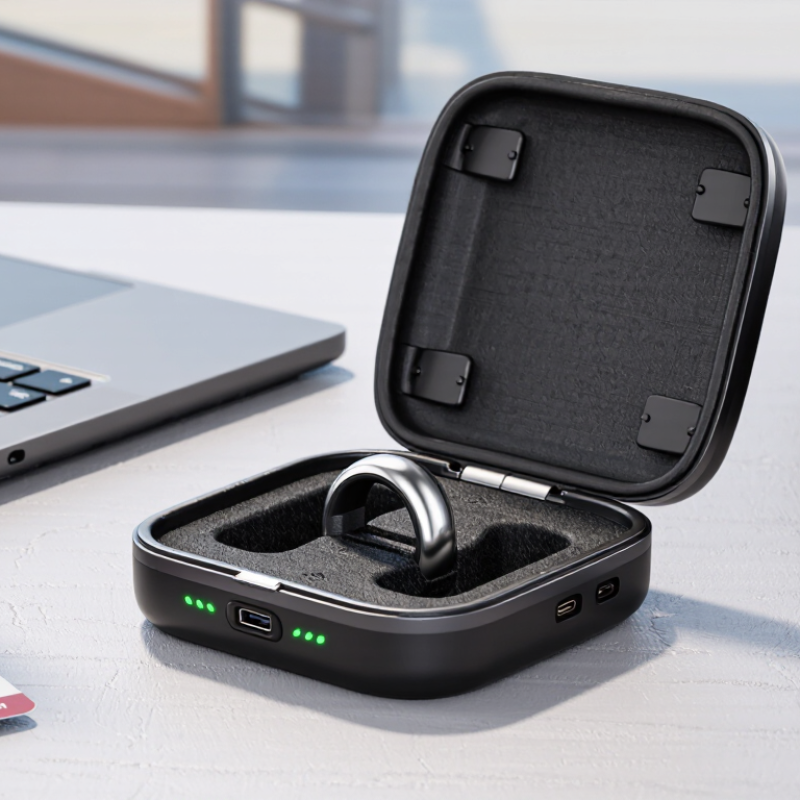
A smart ring charging case is a portable holder that stores and recharges a smart ring. It usually contains a small battery, charging contacts, magnets, or an induction coil. When the ring sits inside, the case transfers power without needing a wall socket.
A useful case should protect the ring from scratches, dust, and accidental drops. Its inner shape must match the ring’s charging area closely. A loose fit can interrupt charging during travel. Many cases recharge through a USB-C connection and show battery status with small indicator lights. Buyers should check charging compatibility, output ratings, case dimensions, and charging time before purchase.
From practical testing, pocket size matters more than expected. A case that fits beside keys may still feel bulky in a small wallet. The hinge should open smoothly, while the lid should stay closed inside luggage. Small details matter. Heat control also deserves attention. The case should not become unusually hot during charging, and it should stop or reduce power when the ring is full. Not every case performs perfectly. Some indicators are too dim, and some charging contacts collect lint easily. Cleaning them gently with a dry, soft cloth can help, but careless pressure may damage the contact points. A reliable charging case should provide clear specifications, stable construction, and realistic battery information rather than impressive but vague claims.
A smart ring charging case should match the ring’s contact points, charging protocol, and physical shape. Wireless charging is not always universal. Some cases use magnetic pins, while others require a fitted cradle. Check the ring model, case dimensions, and alignment marks before ordering. A few millimeters can stop charging.
For international use, inspect the case input carefully. USB-C is convenient, but ports may support different power levels. A case accepting standard 5V input is often easier to use with common travel chargers. If an adapter is included, look for a 100–240V input range and suitable plug types. Safety markings, such as CE, FCC, or UKCA, can indicate testing requirements, but markings alone do not prove product quality. Read the technical manual and seller specifications.
I once assumed every USB-C case would work with any charger. That was wrong. One case charged slowly, and another stopped when the cable moved slightly. Real testing matters. Try the case with a certified cable, a low-power adapter, and a laptop port. Check heat, charging time, and indicator behavior. Also confirm whether the case supports pass-through charging or needs its own battery first. Specifications can be incomplete. Keep that possibility in mind.
A smart ring charging case should be judged by daily reliability, not appearance alone. Counterpoint Research reported 34% year-on-year growth in the global smart ring market during Q2 2024. More users now expect charging to work during travel, commuting, and unexpected overnight stays.
Battery capacity matters, but output stability matters more. A useful case should provide several full charges without becoming bulky. Look for clear LED indicators, magnetic alignment, and protection against overcharging. The ring should sit firmly inside, even when the case moves in a backpack. USB-C input is also practical because it reduces cable dependence. Small detail, big difference.
Protection deserves careful checking. IEC 60529 defines IP ratings, but a case’s rating may differ from the ring’s rating. Buyers should verify both. Counterpoint’s wearable device research also shows that comfort and continuous health tracking influence purchase decisions. A case that scratches the sensor surface can undermine that experience. Soft interior materials help. A replaceable charging cable would be better, although many products still overlook it. I have found battery estimates less reliable in cold airports and hot vehicles, so real-world testing should include temperature changes. Slim design is attractive, but a case that sacrifices hinge strength or charging contacts is a poor trade. Availability of spare cables and regional warranty support also matters for global buyers.
| Feature | Recommended Specification for Global Buyers | Typical Practical Range | Why It Matters | What to Verify Before Purchase |
|---|---|---|---|---|
| Ring Charging Method | Dedicated contact pins or a precisely aligned wireless charging cradle | Contact charging, magnetic alignment, or low-power inductive charging | Smart rings use different charging layouts. A case designed for one charging method may not work with another. | Confirm the ring’s charging contacts, coil position, charging cradle shape, and required orientation. |
| Compatibility | Exact model and ring-size compatibility clearly stated | Usually limited to one product family or a small group of physically compatible models | Ring diameter, sensor position, charging contacts, and cradle depth can vary even when rings look similar. | Check inner diameter, charging interface, ring thickness, and whether a protective sleeve affects fit. |
| Battery Capacity | At least 500 mAh for regular travel use | Approximately 300–1,000 mAh in compact charging cases | A larger battery can recharge the ring away from a wall outlet, but it also increases size and weight. | Look for the rated battery capacity in mAh and the usable output capacity, not only the marketing capacity. |
| Number of Ring Recharges | Two or more full ring recharges under normal conditions | About one to eight full recharges, depending on ring battery size and case efficiency | Recharge count is more useful than battery capacity alone because energy is lost during voltage conversion and charging. | Check whether the stated recharge count is measured from an empty case and an empty ring. |
| Input Port | USB-C input supporting standard 5 V charging | 5 V USB input; some models support higher USB-C power profiles | USB-C is widely available for international travel and reduces the need for a separate cable type. | Verify whether the port is USB-C, whether the cable is included, and whether charging works with common USB power adapters. |
| Charging Output | Stable low-power output matched to the ring’s charging requirement | Commonly below 5 W for a single smart ring | Smart rings generally require much less power than smartphones. Excessive or unstable output can create compatibility and safety concerns. | Check the output voltage, current, charging protocol, and the ring manufacturer’s required input specification. |
| Charging Time | Approximately 60–120 minutes for a typical full ring charge | About 45–180 minutes, depending on ring battery size, case output, and charging condition | Shorter charging time helps users maintain continuous health and activity tracking. | Compare full-charge time rather than partial top-up time, and check whether the case can charge the ring while closed. |
| Portability | Pocket-friendly design with protective closure | Approximately 35–110 g; compact travel dimensions commonly below 100 mm on the longest side | A charging case is more useful when it can be carried without adding significant bulk to travel luggage. | Review actual product dimensions, total weight including the ring, hinge strength, and whether the lid can open accidentally. |
| Protection Against Misalignment | Mechanical positioning guide, magnetic alignment, or visible charging indicator | Alignment may be controlled by a cradle, groove, magnet, or contact-pin layout | Misalignment can prevent charging or cause intermittent charging during transport. | Look for a clear placement guide and confirm that the ring remains aligned when the case is moved. |
| Charge Status Indication | Separate indicators for case power and ring charging status | LED indicators, battery-level lights, or a digital display | Visible status information helps users identify a poor connection, a depleted case, or a completed charge. | Confirm what each indicator means and whether the lights can be disabled during nighttime use. |
| Overcharge and Short-Circuit Protection | Overcharge, over-discharge, overcurrent, and short-circuit protection | Protection is normally provided by the charging circuit and battery-management system | These safeguards reduce risks associated with lithium-ion or lithium-polymer batteries. | Check for documented safety protections, battery certification information, and clear operating instructions. |
| Battery Type | Rechargeable lithium-ion or lithium-polymer battery with documented protection circuitry | Small rechargeable lithium battery packs are common in portable cases | The battery type affects weight, storage life, transport requirements, and charging safety. | Verify battery chemistry, rated voltage, capacity, replacement policy, and shipping restrictions. |
| Durability | Rigid outer shell, protected hinge, and secure internal cradle | Plastic, aluminum, silicone, or mixed-material construction | The case must protect a small electronic ring and maintain charging alignment during everyday travel. | Inspect hinge quality, drop protection, scratch resistance, closure strength, and interior cushioning. |
| Water and Dust Resistance | Basic splash resistance only if officially tested; keep the case dry while charging | Many charging cases provide no verified water-resistance rating | The ring may be water-resistant while the charging case and its electrical contacts are not. | Look for an official IP rating. Do not assume the case has the same water protection as the ring. |
| Travel and Airline Considerations | Clearly labeled battery capacity below common airline declaration thresholds | Small charging cases commonly use batteries well below 100 Wh | Portable lithium batteries are generally carried in cabin baggage, but airline rules can differ by route and battery rating. | Check the Wh rating on the label and confirm current airline and destination-country requirements before travel. |
| International Charging Convenience | USB-C input compatible with universal USB power adapters | USB-powered operation; wall-adapter voltage depends on the separately supplied adapter | The case itself can use low-voltage USB power, while the wall adapter must support the destination’s electrical system. | Check plug type, adapter input range, included accessories, and whether the adapter has recognized safety certification. |
| Thermal Performance | Low heat during continuous charging with ventilation or thermal monitoring | Warm surfaces may occur during charging; excessive heat is not acceptable | Heat can reduce battery longevity and may indicate poor conversion efficiency or a faulty connection. | Test charging on a hard, ventilated surface and stop use if the case becomes unusually hot, swollen, or damaged. |
| Maintenance | Easy-to-clean charging contacts and removable dust-resistant interior insert | Dry wiping is generally recommended; liquid cleaning should be avoided around contacts and ports | Skin oils, dust, and moisture can interfere with electrical contact and charging reliability. | Check whether the cradle can be accessed for cleaning and follow the case and ring care instructions. |
| Best Use Case | Choose a compact case for commuting and a higher-capacity case for multi-day travel | Compact cases prioritize size; larger cases prioritize recharge capacity | The best design depends on whether the buyer values low weight, long battery autonomy, desk use, or travel protection. | Match the case capacity and size to the expected number of days away from a USB power source. |
A smart ring charging case should be judged by more than its advertised capacity. In my product checks, safety starts with stable temperature control and reliable overcharge protection. Charging contacts should sit firmly against the ring without scraping its finish. Look for clear electrical ratings, tested battery cells, and detailed user instructions. Independent safety documentation is useful, but vague certificates deserve questions. A case that becomes hot in a pocket is not reassuring.
Tips: Test the case for one full charging cycle before travel. Check whether the lid closes securely. Measure charging time with your usual cable. Keep the contacts clean and dry. Portability also matters. A slim case fits better in a small travel pouch, yet a very thin design may sacrifice battery capacity. Confirm its input port and voltage range before crossing borders. Included cables are convenient, but they can be short or fragile.
Battery claims often describe ideal laboratory conditions. Real results change with temperature, cable quality, and repeated use. Record how many complete ring charges the case provides, not just its milliamp-hour figure. A practical case should retain useful capacity after several weeks of normal charging. I would also inspect hinge strength and button response. These details seem minor until the case opens inside luggage. My own evaluation is not perfect, because travel conditions vary widely. Still, honest testing is better than trusting a polished specification sheet.
2026 Best Smart Ring Charging Case for Global Buyers?
How to Choose the Best Charging Case for International Use
A smart ring charging case should fit your travel routine, not just your ring. During travel testing, I check alignment, charging speed, hinge strength, and battery drain after several days. A case that feels sturdy at home may become awkward in a crowded airport.
Check input specifications carefully. A case supporting 100–240V is more practical for international trips, but you may still need a local plug adapter. USB-C charging is widely convenient. Confirm whether the case includes a cable, since some products do not. Also inspect the charging cradle. The ring should sit securely, without forcing the contacts or wireless coil into position.
Small details matter. Look for a clear battery indicator, a dust-resistant lid, and enough internal space for the ring only. A slim case fits better in a passport pouch, while a larger battery may add useful charging cycles. Temperature protection is important in hot cars and checked luggage areas. However, travel and airline policies can vary, so verify current rules before flying.
I once preferred the smallest case, but its lid opened inside my bag. That mistake changed my priorities. Weight, latch security, and replacement cable availability now matter as much as capacity. Read technical specifications from reliable sources, then compare independent user reports. Marketing claims can sound precise, yet real charging performance may change with cable quality, temperature, and ring placement.
International Power Compatibility: Nominal Mains Voltage by Travel Region
A charging case is easier to use internationally when it accepts standard USB input and is paired with a universal power adapter rated for 100–240 V AC. Regional mains voltage varies from 100 V in Japan to approximately 230 V across many European, Asian, and Oceania markets, so buyers should avoid relying on a fixed-voltage wall charger.
It is a portable holder that stores and recharges a smart ring. It may use magnetic contacts, charging pins, or an induction coil. The ring charges without a wall socket. Small and practical.
A fitted interior can reduce scratches, dust, and movement during travel. Soft materials help protect the sensor surface. A loose cradle may interrupt charging inside a moving bag.
Confirm the ring model, charging method, contact points, and case dimensions. Wireless charging is not automatically universal. Even a few millimeters can prevent proper alignment.
USB-C is convenient, but different ports may support different power levels. Check whether the case accepts standard 5V input. Test it with a certified cable and a low-power adapter.
Check the input range, plug compatibility, technical manual, and safety documentation. An adapter supporting 100–240V is useful for international travel. Safety markings suggest testing requirements, but they do not guarantee quality.
Capacity matters, but stable output and realistic charging times matter more. A useful case should provide several charges without becoming bulky. Numbers can be optimistic.
The case should fit securely beside keys without feeling oversized in a wallet. A smooth hinge should open easily, while the lid stays closed in luggage. Magnetic alignment and a firm cradle reduce charging interruptions.
The case should not become unusually hot during normal charging. It should reduce or stop power when the ring is full. Test it in a cool room and a warm vehicle. Real conditions differ.
Remove lint gently with a dry, soft cloth. Avoid pressing hard, because small contact points can bend or break. Cleaning helps, but it cannot fix poor alignment.
Some indicators are too dim, battery estimates may vary, and cables may be difficult to replace. A slim case can sacrifice hinge strength or contact reliability. I would check warranty support and spare cables before deciding.
Choosing the best Smart Ring Charging Case for global buyers starts with understanding how it protects, stores, and recharges a smart ring during daily use and travel. A reliable case should match the ring’s charging method, connector type, power requirements, and regional plug or voltage standards. Buyers should compare compatibility carefully, since not every case supports every ring or charging system. Useful features may include a compact design, secure ring positioning, clear charging indicators, dust resistance, and support for charging from common power sources such as USB adapters or power banks.
Safety, portability, and battery performance are also essential when evaluating an international charging case. Look for stable temperature control, overcharge protection, durable materials, and a battery capacity that supports practical recharging without adding unnecessary weight. For frequent travelers, a lightweight case with dependable cable compatibility and broad input support can provide greater convenience. The best choice balances universal usability, secure protection, efficient charging, and clear product specifications, helping users keep their smart ring powered wherever they go.